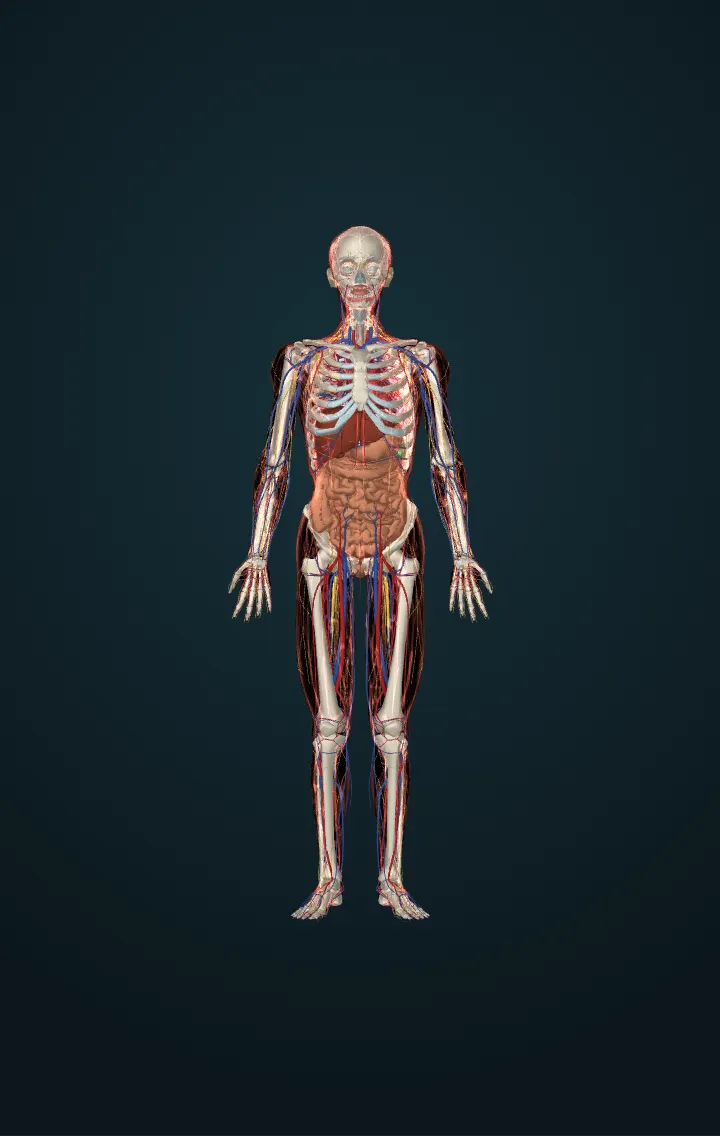
A complete human body in 3D that you can turn, peel and look inside. Every part is named in your language, the main organs are explained in words and aloud, and the body is alive: its heart beats and its lungs breathe, and they answer what the body does. The main organs open into simulators of their own.
How to use it
- Turn the body with one finger or the mouse; pinch or scroll to zoom; drag with two fingers to move it.
- Peel it with the slider at the side, from the skin down to the bones, or show and hide whole systems.
- Tap any part to see its name and what it does, and press Listen to hear it explained.
- Search for any part by its name, in your language, in Latin or in English.
- Open an organ's simulator from the Organs list or Experiments to watch it work and change how it works.
How the simulator works
The anatomy is BodyParts3D, an adult male body made from medical imaging by the Database Center for Life Science, with organs from the Human Reference Atlas. Both are open data, credited on every page.
The heartbeat, the breathing and the monitor's numbers come from a physiological model of a standard adult, with their sources named. The numbers are rounded, and time that runs faster than real is always marked.
The Monitor button opens a bedside monitor. Its arterial pressure (ART) and breathing (RESP) waves are the model's own signals, beat by beat and breath by breath. The ECG is timed by the model's beat and shaped after McSharry et al. 2003. The pulse oximeter's wave is the arterial pressure 0.15 s later and smoothed, as at a fingertip. The CO₂ wave is a drawn shape at the end-tidal level, taken as 3 mmHg below the arterial CO₂ (Nunn and Hill 1960). Its trends keep the last three hours of simulated time, with each change marked.
It is a model for learning, not a medical device. It never measures you, and it is not medical advice.
Sources
- BodyParts3D, © The Database Center for Life Science, licensed under CC BY-SA 2.1 Japan — adapted: the models are in /models/humanbody under the same licence.
- Credits
For learning only — not medical advice.