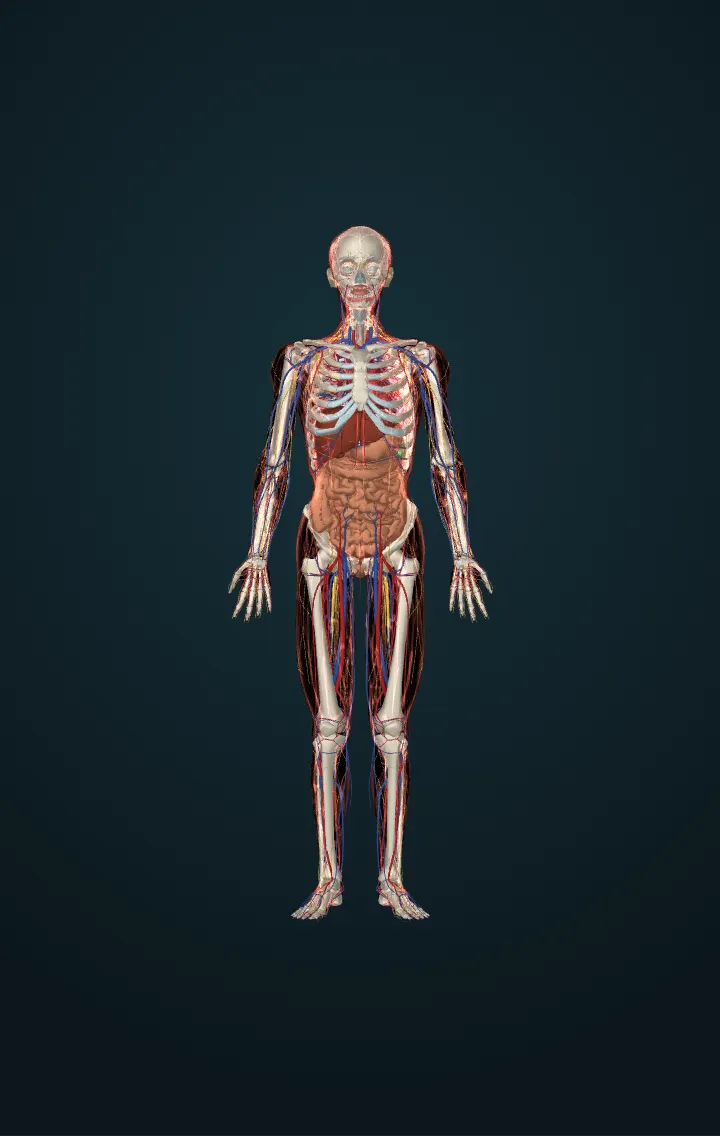
Pituitary gland
A pea-sized gland under the brain that controls many of the body's other glands.
Pituitary gland anatomy is that of one small organ with two lobes: a front lobe of gland tissue and a back lobe of nerve tissue, each arising from a different embryonic tissue. The pituitary, or hypophysis, is about 1 cm across, the size of a pea. With the hypothalamus above it, it forms the command centre of the endocrine system. Some of its hormones act on tissues directly; others, the tropic hormones, switch other glands on and off: the thyroid, the adrenal cortex and the testes or ovaries.
It rests in the sella turcica, a saddle-shaped hollow in the sphenoid bone in the floor of the skull, where bone almost surrounds it. A slender stalk, the infundibulum, ties it to the hypothalamus, part of the brain's diencephalon. The optic chiasm, where the optic nerves from the two eyes meet and some of their fibres cross, lies directly above it. The superior hypophyseal artery, a branch of the carotid arteries, carries blood to the hypothalamus, and its branches form the hypophyseal portal system that leads to the front lobe.
The front lobe, the anterior pituitary or adenohypophysis, grows from the lining of the embryo's primitive mouth, part of its early digestive tract, and moves up towards the brain. It has three regions: the pars distalis at the front, the pars intermedia beside the back lobe, and the pars tuberalis, a slender tube wrapped round the stalk. The back lobe, the posterior pituitary or neurohypophysis, is an extension of the brain: it is made of the endings of nerve cells whose bodies lie in the hypothalamus's paraventricular and supraoptic nuclei.
The two lobes are controlled in different ways. The hypothalamus sends releasing and inhibiting hormones to the front lobe through the hypophyseal portal system, a bridge of capillaries in the stalk that carries them there without passing through the general circulation. The front lobe answers with growth hormone, thyroid-stimulating hormone, adrenocorticotropic hormone, follicle-stimulating hormone, luteinising hormone and prolactin. The back lobe makes no hormones of its own. It stores two made in the hypothalamus and releases them into the blood when its nerve cells fire: antidiuretic hormone, which makes the kidneys take back water, and oxytocin, which makes the uterus contract in childbirth and lets milk flow.
Numbers
| Size, adult | about 1 cm across | NCI SEER Training Modules — Pituitary and Pineal Glands |
|---|---|---|
| Main hormones of the front lobe | 6: growth hormone, prolactin, TSH, ACTH, FSH, LH | OpenStax, Anatomy and Physiology (1st ed., CC BY-NC-SA 4.0: linked, never copied) — 17.3 The Pituitary Gland and Hypothalamus |
| Hormones stored by the back lobe | 2: antidiuretic hormone and oxytocin | OpenStax, Anatomy and Physiology (1st ed., CC BY-NC-SA 4.0: linked, never copied) — 17.3 The Pituitary Gland and Hypothalamus |
Its parts in the model
- Pituitary gland
Sources
- NCI SEER Training Modules — Pituitary and Pineal Glands
- OpenStax, Anatomy and Physiology (1st ed., CC BY-NC-SA 4.0: linked, never copied) — 17.3 The Pituitary Gland and Hypothalamus
- OpenStax, Anatomy and Physiology (1st ed., CC BY-NC-SA 4.0: linked, never copied), 7.2 The Skull
- OpenStax, Anatomy and Physiology (1st ed., CC BY-NC-SA 4.0: linked, never copied) — 16.3 The Cranial Nerve Exam
- Gray, Anatomy of the Human Body (20th ed., 1918, public domain), The Hypophysis Cerebri, pp. 1275–1276
- BodyParts3D, © The Database Center for Life Science, CC BY-SA 2.1 Japan — adapted.