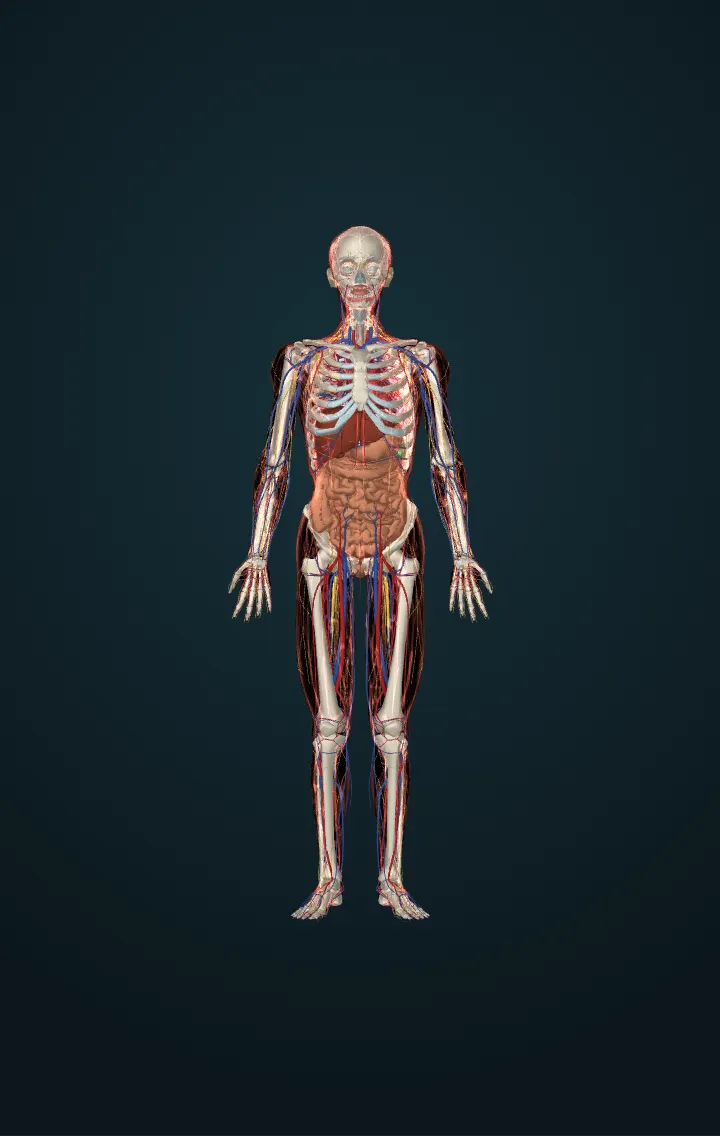
Pancreas
A gland behind the stomach that makes digestive enzymes and the hormones insulin and glucagon.
Pancreas anatomy is a mix of two kinds of gland in one soft, oblong organ. Most of it is exocrine: it makes pancreatic juice, more than a litre a day, and sends it through ducts into the duodenum, in the small intestine. Scattered through it are the pancreatic islets, clusters of endocrine cells that release hormones, among them insulin and glucagon, straight into the blood.
The pancreas lies crosswise behind the stomach, at the back of the abdomen and behind the peritoneum. Its head sits in the C-shaped curve of the duodenum; its body runs to the left and ends as a tapering tail at the hilum of the spleen. Behind its head lie the inferior vena cava, the common bile duct, the renal veins and the aorta.
It has a head, a neck, a body and a tail, and a prolongation of the head, the uncinate process. The exocrine part is made of grape-like clusters of cells, the acini, at the ends of tiny ducts. These merge into two main ducts: the larger joins the common bile duct and opens with it into the duodenum, and the smaller, the accessory duct, when present, opens about 2.5 cm higher. Each islet holds four kinds of cell: beta cells, about 75 per cent, make insulin; alpha cells, about 20 per cent, glucagon; delta cells, 4 per cent, somatostatin; and PP cells, about 1 per cent, pancreatic polypeptide.
The acini release enzymes for starch (amylase), fats (lipase) and nucleic acids (nuclease) in their active forms, but the protein-digesting enzymes in inactive forms, so that they do not digest the pancreas itself. Sodium bicarbonate makes the juice slightly alkaline, so that it buffers the acid arriving from the stomach. Two gut hormones set the pace: acid entering the duodenum releases secretin, which calls for juice rich in bicarbonate, and proteins and fats release cholecystokinin, which calls for juice rich in enzymes. A rise in blood glucose releases insulin, which helps body cells take glucose in; a fall releases glucagon, which makes the liver turn its glycogen back into glucose.
Numbers
| Length, adult | 12.5–15 cm | Gray, Anatomy of the Human Body (20th ed., 1918, public domain), The Pancreas, pp. 1199–1201 |
|---|---|---|
| Weight, adult | 60–100 g | Gray, Anatomy of the Human Body (20th ed., 1918, public domain), The Pancreas, pp. 1199–1201 |
| Pancreatic juice made | more than 1 litre a day | OpenStax, Anatomy and Physiology (1st ed., CC BY-NC-SA 4.0: linked, never copied) — 23.6 Accessory Organs in Digestion: The Liver, Pancreas, and Gallbladder |
| Blood glucose that insulin and glucagon hold | between 70 and 110 mg/dL | OpenStax, Anatomy and Physiology (1st ed., CC BY-NC-SA 4.0: linked, never copied) — 17.9 The Endocrine Pancreas |
Its parts in the model
- Pancreas
- Pancreatic duct
- Pancreatic duct tree
- Parenchyma of pancreas
Sources
- Gray, Anatomy of the Human Body (20th ed., 1918, public domain), The Pancreas, pp. 1199–1201
- OpenStax, Anatomy and Physiology (1st ed., CC BY-NC-SA 4.0: linked, never copied) — 23.6 Accessory Organs in Digestion: The Liver, Pancreas, and Gallbladder
- OpenStax, Anatomy and Physiology (1st ed., CC BY-NC-SA 4.0: linked, never copied) — 17.9 The Endocrine Pancreas
- NCI SEER Training Modules — Accessory Organs (of digestion)
- BodyParts3D, © The Database Center for Life Science, CC BY-SA 2.1 Japan — adapted.