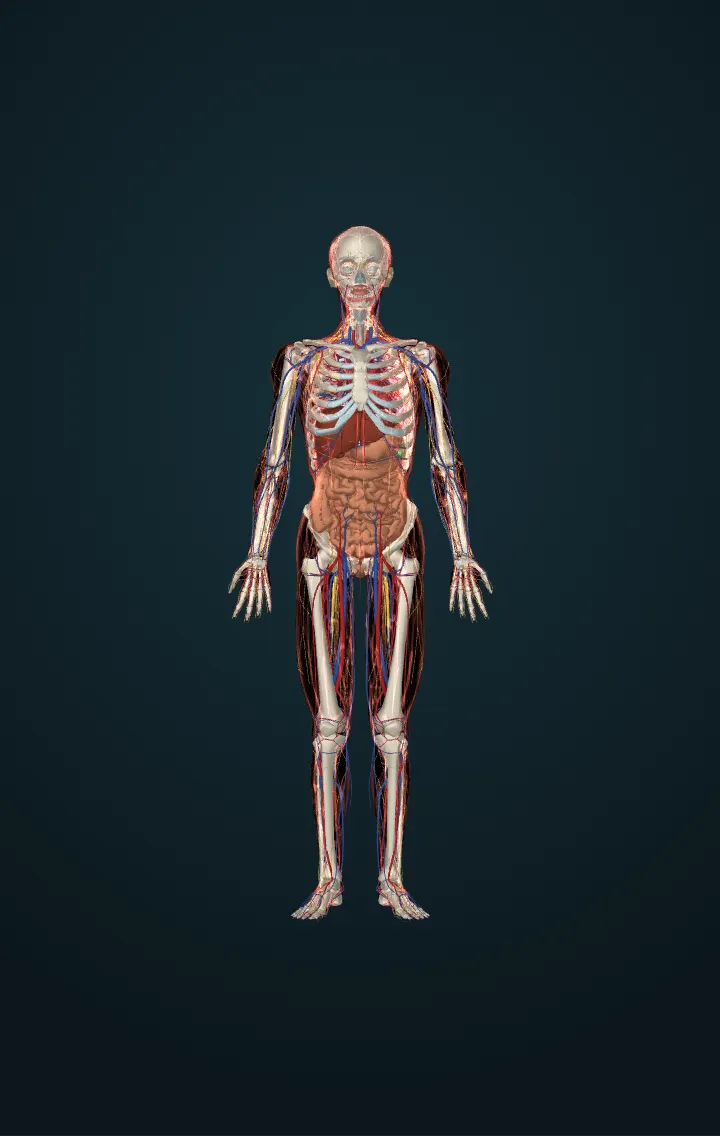
Spleen
An organ in the upper left of the abdomen that filters the blood and helps fight infection.
Spleen anatomy centres on two tissues, the red pulp and the white pulp, inside the largest lymphatic organ in the body. The spleen filters the blood much as the lymph nodes filter lymph. It is a soft, fragile organ without a strong capsule, dark red because it is so full of blood vessels.
It lies in the upper left of the abdomen, just beneath the diaphragm and behind the stomach. The diaphragm separates it from the ninth, tenth and eleventh ribs on the left. Its inner surface touches the back of the stomach and, further back, the left kidney; its lower end rests on the left bend of the colon and usually touches the tail of the pancreas. The gastrosplenic ligament ties it to the outer border of the stomach. Near its inner border is a long slit, the hilum, where its vessels pass in and out.
A capsule of connective tissue covers it and sends partitions, the trabeculae, inwards, dividing it into lobules. The red pulp is made of blood-filled venous sinuses and of reticular fibres carrying macrophages and all the other cells of the blood. The white pulp is lymphatic tissue sheathing the small arteries: round each central arteriole lie germinal centres of dividing B cells, surrounded by T cells, macrophages and dendritic cells. Between the two lies the marginal zone, which catches particulate antigens from the passing blood and presents them to the lymphocytes of the white pulp.
Blood enters through the splenic artery, which splits into arterioles sheathed in white pulp and then into sinusoids; it collects in the venous sinuses and leaves through the splenic vein. On the way, macrophages and dendritic cells take out microbes and other material, including dying red blood cells, which live up to 120 days. Its sinuses are also a store of blood: in an emergency such as heavy bleeding, smooth muscle in the capsule and the vessel walls contracts and squeezes this blood into the circulation. A person can live without a spleen, as other organs such as the liver take over some of its work, though the body then loses some of its ability to fight infections.
Numbers
| Length, adult | about 12 cm | OpenStax, Anatomy and Physiology (1st ed., CC BY-NC-SA 4.0: linked, never copied) — 21.1 Anatomy of the Lymphatic and Immune Systems |
|---|---|---|
| Breadth and thickness, adult | about 7 cm and 3–4 cm | Gray, Anatomy of the Human Body (20th ed., 1918, public domain), The Spleen (Lien), pp. 1282–1283 |
| Size | about as big as a fist | MedlinePlus (National Library of Medicine) — Spleen Diseases |
| Life of a red blood cell | up to 120 days | OpenStax, Anatomy and Physiology (1st ed., CC BY-NC-SA 4.0: linked, never copied) — 18.3 Erythrocytes |
Its parts in the model
- Spleen
Sources
- OpenStax, Anatomy and Physiology (1st ed., CC BY-NC-SA 4.0: linked, never copied) — 21.1 Anatomy of the Lymphatic and Immune Systems
- Gray, Anatomy of the Human Body (20th ed., 1918, public domain), The Spleen (Lien), pp. 1282–1283
- MedlinePlus (National Library of Medicine) — Spleen Diseases
- OpenStax, Anatomy and Physiology (1st ed., CC BY-NC-SA 4.0: linked, never copied) — 18.3 Erythrocytes
- NCI SEER Training Modules — Spleen
- BodyParts3D, © The Database Center for Life Science, CC BY-SA 2.1 Japan — adapted.