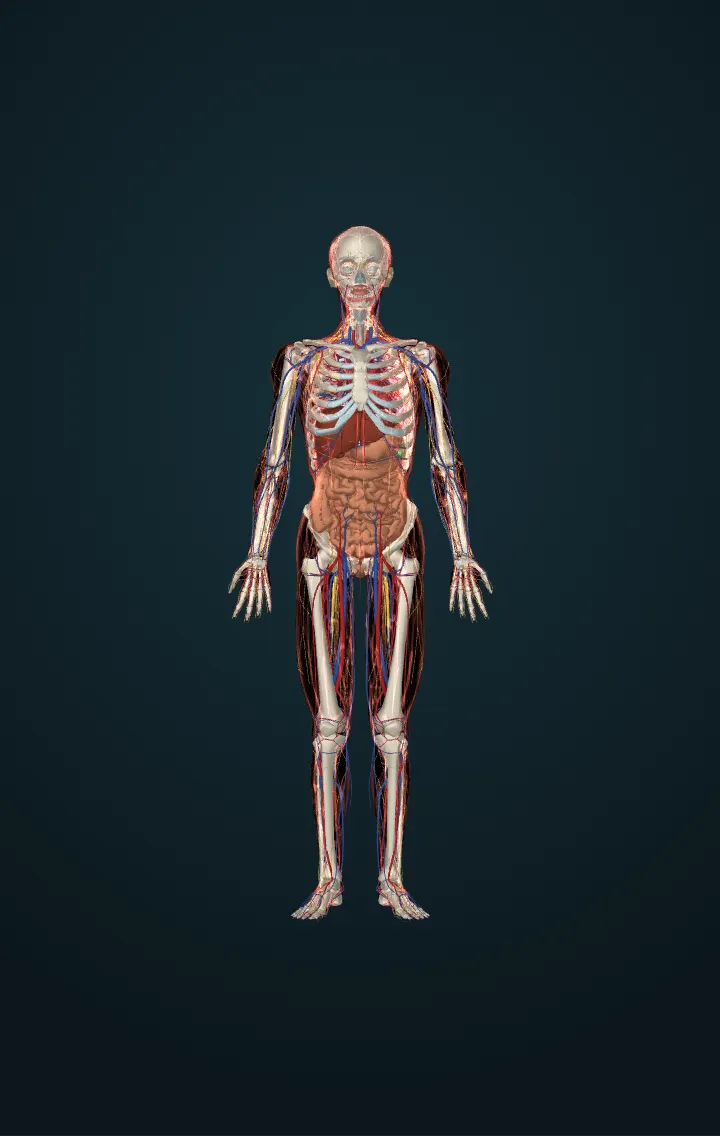
Adrenal glands
Two small glands on top of the kidneys that make adrenaline and cortisol.
Adrenal gland anatomy pairs two tissues in each gland: an outer cortex of gland tissue and an inner medulla of nervous tissue, which develop from different tissues in the embryo and make different hormones. There are two adrenal, or suprarenal, glands, one on top of each kidney. The cortex makes steroid hormones that act on salt and water, blood sugar and long-term stress, and it is essential to life. The medulla makes adrenaline and noradrenaline for sudden stress, and it can be removed without danger to life.
Each gland is a flattened, yellowish body at the back of the abdomen, behind the peritoneum, fixed to the top of its kidney by a fibrous capsule and wrapped in fatty tissue. The right gland is roughly triangular and lies behind the inferior vena cava and the liver, in front of the diaphragm. The left is crescent-shaped, usually a little larger, and lies along the inner border of the upper part of the left kidney, with the stomach, the pancreas and the splenic artery in front of it. Several arteries from the aorta give the glands one of the highest rates of blood flow in the body.
The cortex has three zones. The outermost, the zona glomerulosa, makes mineralocorticoids, mainly aldosterone. The middle zona fasciculata, its cells in small bundles separated by tiny blood vessels, makes glucocorticoids, mainly cortisol. The innermost zona reticularis makes small amounts of androgens, a group of sex hormones. The medulla is made of chromaffin cells, which are sympathetic nerve cells of a special kind.
Each part has its own control. Aldosterone is released when blood potassium rises or blood sodium, pressure or volume falls; it makes the body keep sodium and lose potassium, which raises blood volume and pressure. In long-term stress the hypothalamus releases CRH, the pituitary answers with ACTH, and ACTH drives the cortex to release cortisol, which breaks down stored glycogen, fat and protein to keep the body supplied with fuel. In sudden stress, nerves from the hypothalamus through the thoracic spinal cord stir the medulla, which releases adrenaline and noradrenaline into the blood. They raise blood glucose, speed the heart and raise blood pressure, and the same nerve pathway widens the airways.
Numbers
| Length, adult | usually 3–5 cm | Gray, Anatomy of the Human Body (20th ed., 1918, public domain), The Suprarenal Glands, pp. 1278–1279 |
|---|---|---|
| Adrenaline to noradrenaline made | about 4 to 1 | OpenStax, Anatomy and Physiology (1st ed., CC BY-NC-SA 4.0: linked, never copied) — 17.6 The Adrenal Glands |
| Blood flow | one of the highest rates in the body | OpenStax, Anatomy and Physiology (1st ed., CC BY-NC-SA 4.0: linked, never copied) — 17.6 The Adrenal Glands |
Its parts in the model
- Left adrenal gland
- Right adrenal gland
Sources
- Gray, Anatomy of the Human Body (20th ed., 1918, public domain), The Suprarenal Glands, pp. 1278–1279
- OpenStax, Anatomy and Physiology (1st ed., CC BY-NC-SA 4.0: linked, never copied) — 17.6 The Adrenal Glands
- NCI SEER Training Modules — Adrenal Gland
- BodyParts3D, © The Database Center for Life Science, CC BY-SA 2.1 Japan — adapted.