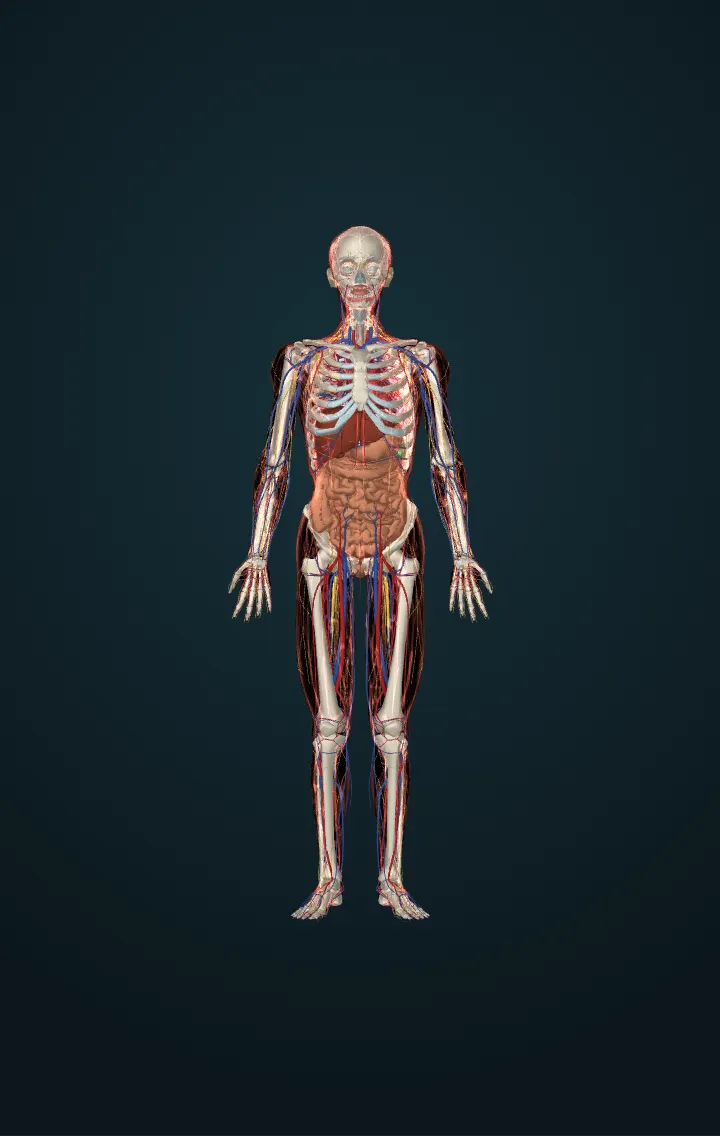
Lungs
Two spongy organs in the chest where air and blood meet, oxygen goes in and carbon dioxide comes out.
Each lung is divided into lobes — three on the right, two on the left, where the heart takes up room — and each lobe into segments. The airways branch some twenty times and end in millions of tiny air sacs, the alveoli, wrapped in capillaries.
Breathing in is the diaphragm and the muscles between the ribs enlarging the chest; air follows. Breathing out at rest is the lungs springing back. The urge to breathe comes mostly from carbon dioxide in the blood, not from a lack of oxygen.
Numbers
| Breathing rate at rest, adult | 12–18 breaths a minute | OpenStax, Anatomy and Physiology (1st ed., CC BY-NC-SA 4.0: linked, never copied) |
|---|---|---|
| Air in one quiet breath | about 0.5 litres | OpenStax, Anatomy and Physiology (1st ed., CC BY-NC-SA 4.0: linked, never copied) |
Its parts in the model
- Inferior lingular bronchial tree
- Lateral segmental bronchial tree
- Left anterior basal segmental bronchial tree
- Left anterior segmental bronchial tree
- Left apical segmental bronchial tree
- Left lateral basal segmental bronchial tree
- Left medial basal segmental bronchial tree
- Left posterior basal segmental bronchial tree
- Left posterior segmental bronchial tree
- Left superior segmental bronchial tree
- Medial segmental bronchial tree
- Right anterior basal segmental bronchial tree
- Right anterior segmental bronchial tree
- Right apical segmental bronchial tree
- Right lateral basal segmental bronchial tree
- Right medial basal segmental bronchial tree
- Right posterior basal segmental bronchial tree
- Right posterior segmental bronchial tree
- Right superior segmental bronchial tree
- Superior lingular bronchial tree
Sources
- OpenStax, Anatomy and Physiology (1st ed., CC BY-NC-SA 4.0: linked, never copied)
- BodyParts3D, © The Database Center for Life Science, CC BY-SA 2.1 Japan — adapted.