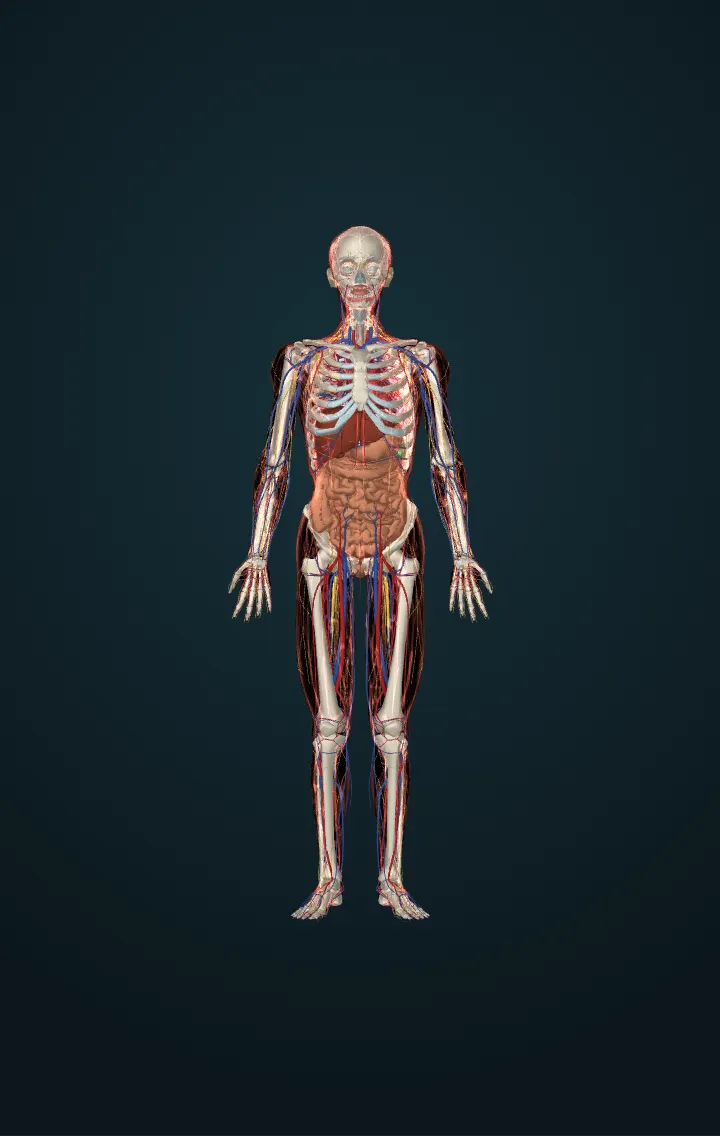
Ear
The organ of hearing and balance, from the outer ear to the cochlea and the semicircular canals.
Sound makes the eardrum vibrate; three tiny bones, the ossicles, pass the vibration to the cochlea, where hair cells turn it into nerve signals. The stapes, the last of them, is the smallest bone in the body.
The inner ear's semicircular canals sense turning of the head and help keep balance.
Numbers
| Smallest bone (the stapes) | about 3 mm | OpenStax, Anatomy and Physiology (1st ed., CC BY-NC-SA 4.0: linked, never copied) |
|---|
Its parts in the model
- Left auricle
- Left bony labyrinth: vestibule, semicircular canals and scala vestibuli
- Left chorda tympani
- Left external acoustic meatus
- Left facial nerve (in the temporal bone)
- Left incus
- Left malleus
- Left stapes
- Left tympanic membrane
- Left vestibulocochlear nerve
- Right auricle
- Right bony labyrinth: vestibule, semicircular canals and scala vestibuli
- Right chorda tympani
- Right external acoustic meatus
- Right facial nerve (in the temporal bone)
- Right incus
- Right malleus
- Right stapes
- Right tympanic membrane
- Right vestibulocochlear nerve
- Scala tympani of left cochlea
- Scala tympani of right cochlea
Sources
- OpenStax, Anatomy and Physiology (1st ed., CC BY-NC-SA 4.0: linked, never copied)
- BodyParts3D, © The Database Center for Life Science, CC BY-SA 2.1 Japan — adapted.